Practical buying maths
Essential Oil Bottle Sizes: Compare Cost per mL and Real Value
Compare oil bottle sizes with cost-per-millilitre examples, delivery costs and set comparisons, without mistaking a larger bottle for a better purchase.
On this page
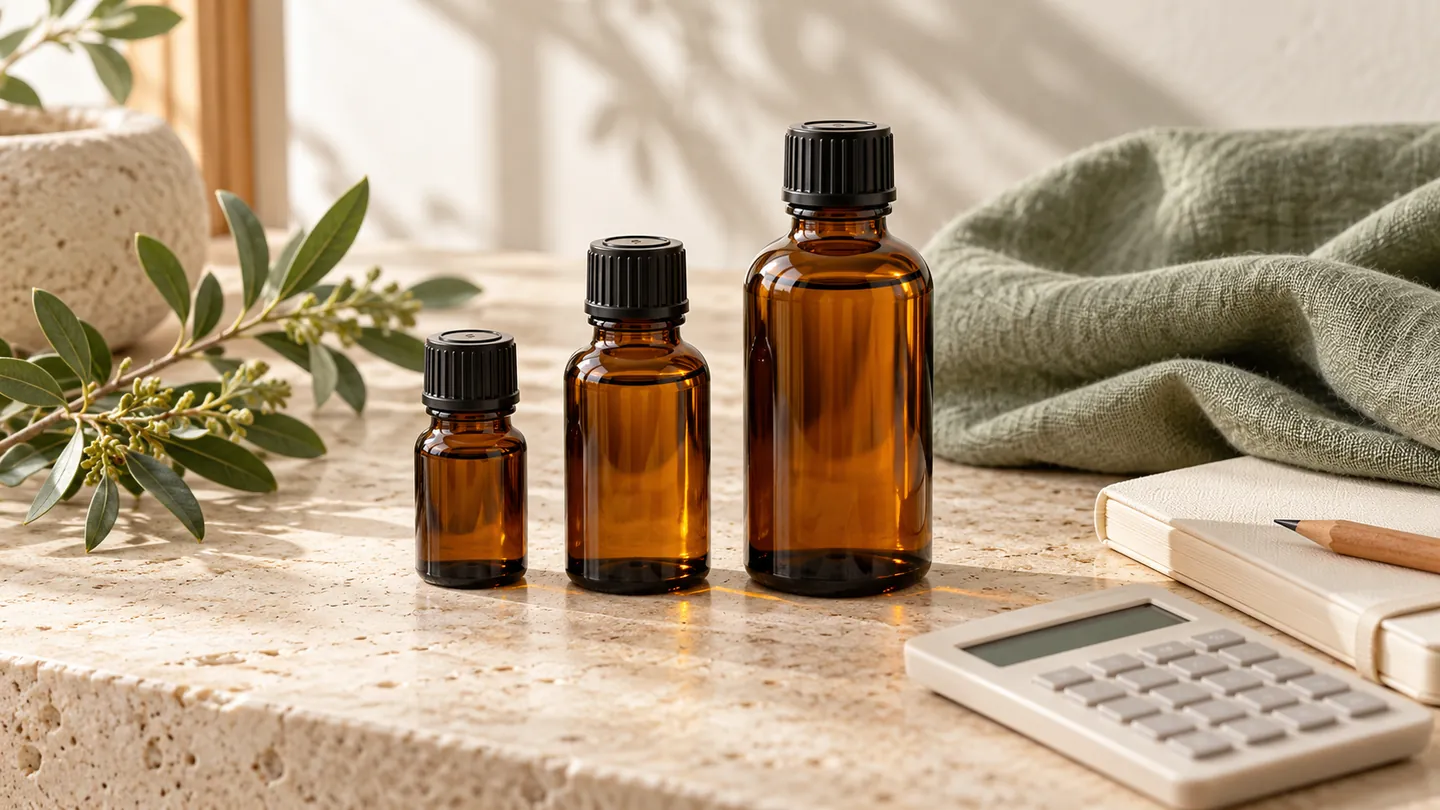
A larger oil bottle can have a lower cost per millilitre while still being the less useful purchase. The useful comparison has two parts: how much of the same product you receive for the money, and whether that quantity fits what you actually need.
This guide explains the arithmetic behind bottle-size comparisons. It does not rank brands, recommend a particular product or present current retailer prices.
Start with the labelled amount
Write down the stated net contents, rather than judging volume from a photograph or the height of the bottle. Keep the measurement unit beside the number: a comparison between “10 mL” and “30 mL” is immediately clearer than one between “small” and “large”.
The FDA's cosmetics labelling guide explains net quantity separately from a cosmetic's identity and ingredient information. That distinction is useful when shopping: the amount in a package and what the product contains are different questions. The guide concerns cosmetics; it is not a claim that every oil sold for every purpose belongs to that regulatory category.
Before doing any calculation, check that you are comparing the same kind of product. Our essential, carrier and fragrance oil guide explains why those categories should not be treated as interchangeable.
Calculate a cost per millilitre
For bottles labelled in millilitres:
Bottle price ÷ labelled volume in mL = cost per mL.
Use the same currency and the same volume unit for every candidate. NIST's unit-pricing overview explains how a price per unit of measure helps shoppers compare quantities and prices. The calculation below applies that general method to fictional oil bottles.
| Hypothetical option | Labelled volume | Fictional bottle price | Calculation | Cost per mL |
|---|---|---|---|---|
| Smaller bottle | 10 mL | $12 | $12 ÷ 10 | $1.20 |
| Larger bottle | 30 mL | $24 | $24 ÷ 30 | $0.80 |
These numbers are invented arithmetic examples, not Amazon prices, quotations or claims about any brand. Assume, only for this example, that both bottles contain the same product and that delivery and other charges are equal.
The larger example costs twice as much upfront and contains three times the volume. Its cost per mL is one-third lower. That establishes the quantity-price difference; it does not establish purity, suitability or how much of it you will use.
Include the costs that change your decision
If delivery or another unavoidable charge differs between offers, make a second comparison using the total you would actually pay. Keep the bottle-only calculation separate so you can see what changed.
For example, suppose delivery adds a fictional $6 to the smaller option above and nothing to the larger one. The delivered comparisons would be $18 ÷ 10 = $1.80 per mL and $24 ÷ 30 = $0.80 per mL. You would still spend $6 more to buy the larger bottle.
This example shows why the lowest unit cost and the smallest cash outlay answer different questions. Check the actual checkout terms for your order rather than assuming that a promotion or delivery threshold applies.
Compare sets without averaging away the differences
A set of three 10 mL bottles has a total labelled volume of 30 mL. That does not make it equivalent to one 30 mL bottle if the set contains three different oils.
Ask what you would otherwise buy. If only one bottle in a set meets your intended purchase, the other two should not automatically count as savings. You can calculate the set's average cost per mL, but that average cannot tell you whether its individual contents are useful to you.
Likewise, establish the ingredients and intended use before comparing a blend, a carrier-oil mixture and a single essential oil. Keep botanical identity and the actual formula in your notes. The buying checklist covers those checks in more detail.
Choose an amount you can justify
Consider the smaller option when you are deciding whether you want that particular product at all, or when a larger quantity would exceed your current plans. Consider a larger size when you already know the exact product you want, the quantity is useful to you and its directions and storage requirements fit your circumstances.
These are purchasing considerations, not a universal bottle-size rule. Follow the product's own directions and storage or expiry information. This guide does not provide a standard shelf life or predict how many uses a bottle will deliver.
An easy final test is to finish this sentence: “I am spending the extra amount because…” If the only answer is “the bottle looks like better value”, return to the quantities, ingredients and total cost before ordering.
A quick comparison worksheet
For each candidate, note:
- The exact product identity, ingredients and intended use.
- The labelled volume and unit.
- The current bottle price in one currency.
- The calculated cost per mL, using consistent units.
- Any delivery or other charges that change the total.
- Why you want that quantity rather than a smaller one.
Keep the current listing or label handy while checking the figures. A calculation cannot repair an unclear ingredient list or establish compatibility with a device; for that purchase, continue with choosing a diffuser.
Sources and approach
Sources checked on 17 October 2026:
- NIST: Uniform Unit Pricing, for the general meaning and use of a unit price.
- FDA: Cosmetics Labeling Guide, for the distinction between net quantity, product identity and ingredient information in cosmetic labelling.
The calculations and purchasing examples are original worked examples. We have not tested products or verified live retailer prices for this article. There are no product recommendations or shopping links in this guide.