Evidence explainer
Peppermint Oil for Skin and Hair: Claims in Context
Separate a cooling sensation and fragrance from evidence of skin treatment or hair growth.
As an Amazon Associate I earn from qualifying purchases. Shopping links may earn us a commission at no extra cost to you. How affiliate links work.
On this page
Peppermint oil has a distinctive scent and cooling sensory effect, but those characteristics do not prove that it treats skin problems or grows hair. A useful assessment needs to identify the outcome, product, and route of use behind each claim.
Start with the route of use
Research on a specially prepared oral peppermint product cannot be treated as evidence for rubbing an essential oil onto skin or scalp. Likewise, a study of one formulation does not settle the effects of a different retail bottle.
NCCIH's peppermint overview discusses research and safety across different uses. Read the details rather than transferring a result from one use to another. NCCIH peppermint oil.
A cooling feeling is not a treatment result
It is easy to describe a sensation as “working.” The more useful question is what measurable outcome it establishes. Feeling cool does not demonstrate that acne has been treated, that an infection has cleared, or that a hair follicle has grown new hair.
If a product is advertised for hair growth, ask whether its evidence involves people, the actual formulation, and the relevant scalp condition. A photograph or a general ingredient story is not the same as a controlled comparison.
Finished haircare versus a DIY addition
A shampoo or scalp product is formulated with several ingredients and directions for use. Adding drops of concentrated oil changes that formulation. We do not provide a recipe for turning an ordinary shampoo into a growth treatment.
When shopping, read the full ingredient list, the application instructions, and any cautions. Products that leave a strong sensation are not necessarily better suited to sensitive or irritated skin.
Safety deserves its own check
NCCIH notes possible skin irritation and warns against applying peppermint oil to the face of an infant or young child. Keep that caution separate from advertising that describes the scent as fresh or soothing.
For general storage and product-use precautions, see essential oil safety. A persistent scalp or skin problem deserves assessment rather than repeated experiments with stronger blends.
What to compare if you want the fragrance
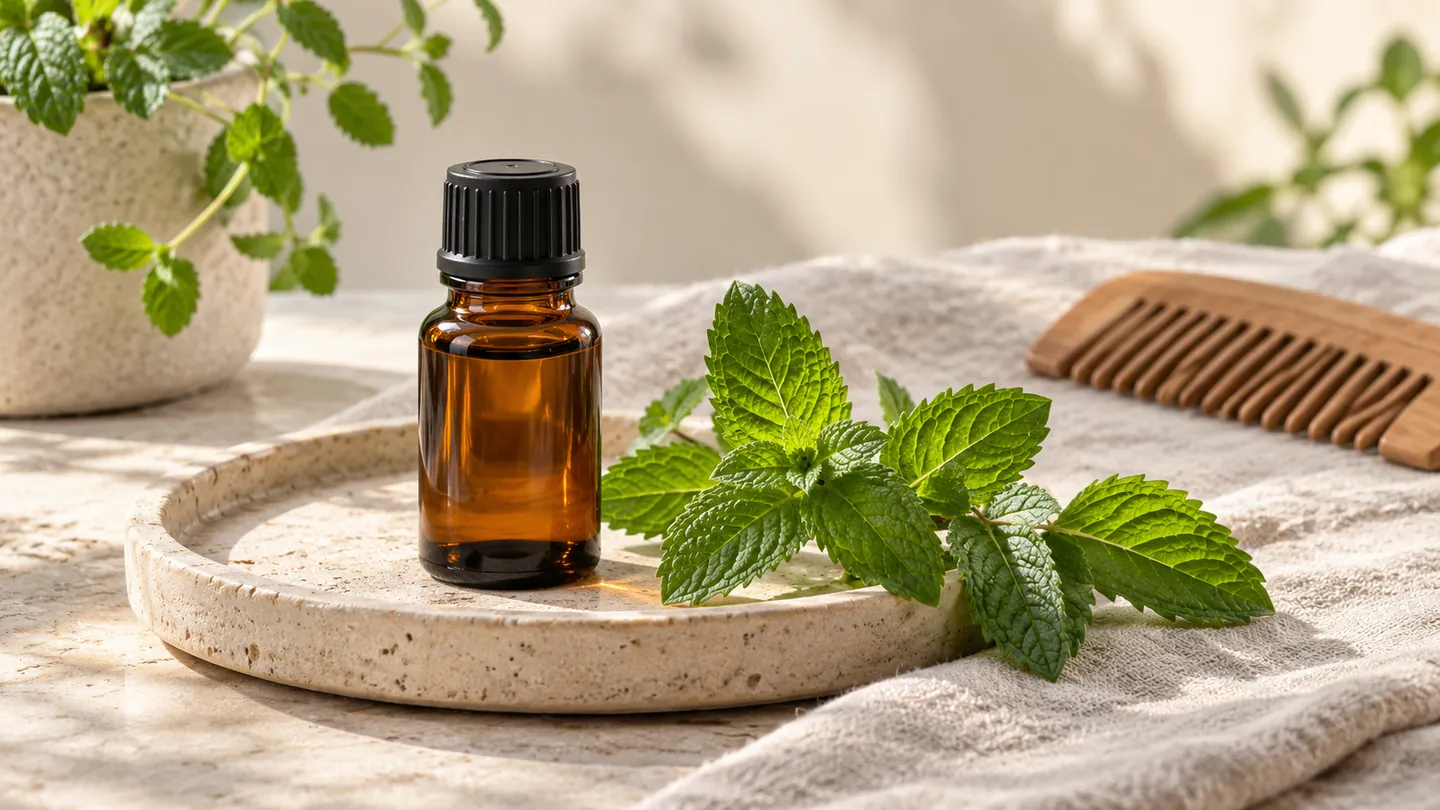
Decide whether you want a compatible diffuser oil or a finished cosmetic. Identify the botanical ingredient, check the intended use, and choose a quantity you can store as directed. Avoid treating “pure” as equivalent to ready for direct skin application.
Search Amazon for peppermint essential oil. Search results are a place to inspect labels, not a list of clinically endorsed treatments.
Sources and approach
Sources: NCCIH peppermint oil and Poison Control peppermint oil. We have not tested a peppermint hair-growth regimen or measured a skincare outcome for this article.