Evidence explainer
Tea Tree Oil Uses: Evidence and Limitations
Read tea tree skincare, haircare, and household claims without confusing marketing with established treatment evidence.
On this page
Tea tree oil appears in skincare, haircare, household recipes, and product advertisements. A list of possible uses is not a list of proven treatments. The important distinction is between how a product is marketed and what evidence supports its actual use.
What is tea tree oil?
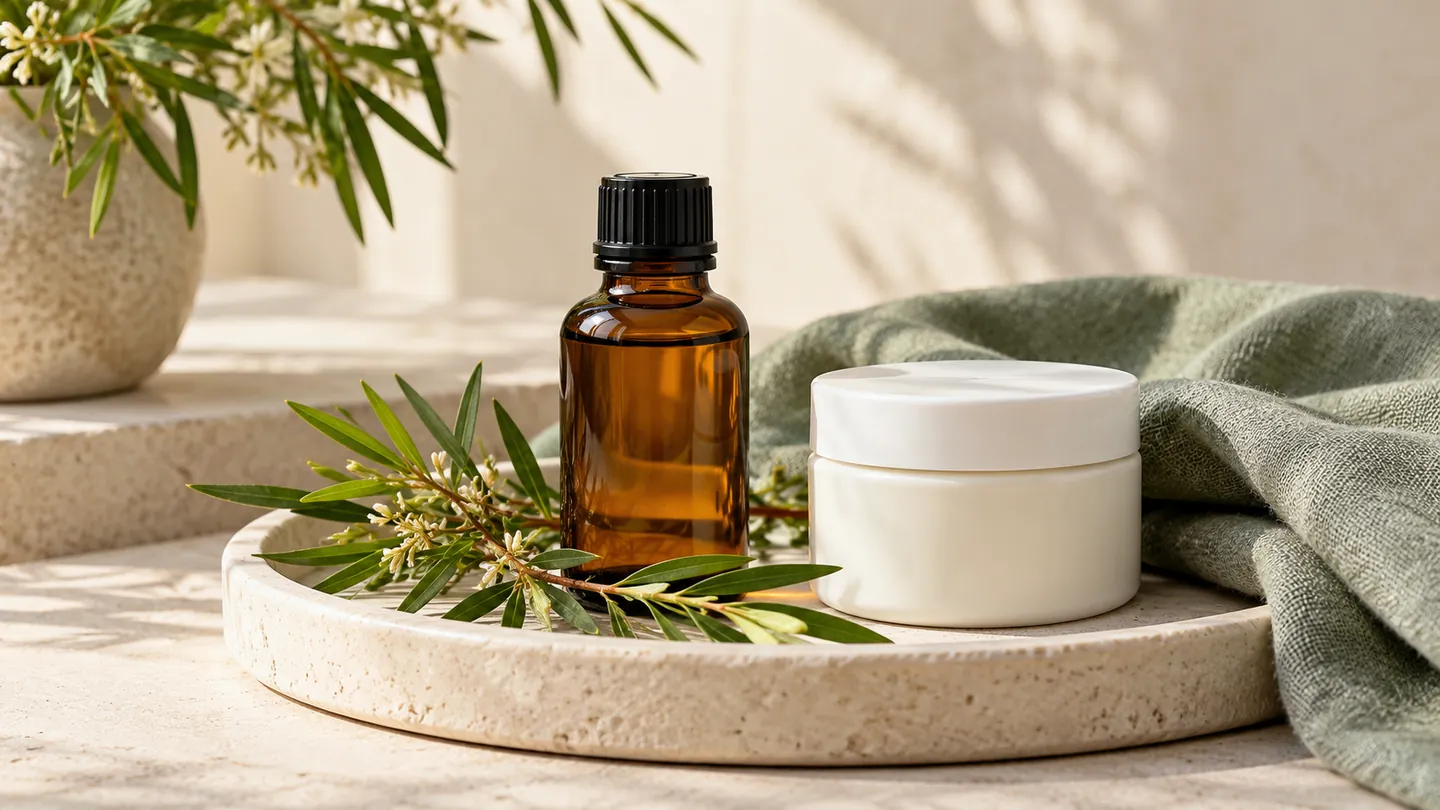
Tea tree essential oil is associated with Melaleuca alternifolia. It is an aromatic concentrate, not a carrier oil or a ready-to-use substitute for every cosmetic containing tea tree. The full formulation and directions matter.
If you are comparing bottles, use our tea tree buying guide. This page focuses on claims and uses instead of repeating a product ranking.
Skin claims need context
NCCIH describes limited evidence for some topical uses, including acne and athlete's foot, and insufficient evidence for many other conditions. That does not justify the broad infection-treatment promises that appeared in the original article. A finding about a particular preparation is not proof for every bottle or recipe. Read the NCCIH summary.
Haircare is about the finished product
A shampoo containing tea tree oil has a formulation, contact time, and instructions. Adding concentrate to a different shampoo creates a different product whose concentration and tolerability you have not established. Evaluate a finished product on its label and the evidence for its claim rather than improvising an equivalent at home.
A recurring scalp problem can have several causes. A shopping guide cannot diagnose it. Seek qualified advice if it persists or worsens.
Fragrance does not establish disinfection
An oil smelling strong or being described as antimicrobial does not show that a homemade cleaner disinfects household surfaces under real conditions. The product, concentration, contact time, surface, and target organism all matter to a disinfection claim.
Choose a cleaning product intended for the job and follow its instructions. Do not mix household chemicals or assume essential oil improves their safety or effectiveness.
Avoid oral-use experiments
Tea tree oil should not be swallowed. Nor should instructions for a commercially formulated mouth product be turned into a recipe using a bottle of concentrate. Poison Control discusses tea tree oil exposures.
Keep bottles labelled and out of reach of children. If exposure causes concern, contact your local poison information service or seek urgent medical advice appropriate to the situation.
How to read an all-purpose claim
Ask what was actually studied, how it was used, and whether the product being sold matches that evidence. If a seller moves from a laboratory observation to a promise about treating people without explaining the gap, treat the promise cautiously.
Continue with essential oil safety and the label checklist.
Sources and approach
This educational guide uses NCCIH and Poison Control sources linked above. It does not endorse a clinical treatment or a DIY disinfectant formula.